
How to Plan a Library Scavenger Hunt for Kids (Free Printable!)
As an Amazon Associate I earn from qualifying purchases.
Libraries are one of the best free homeschool resources, but many kids do not know what is available. My preteens tend to head to the same shelf every single time! My students often need encouragement to explore new things — and a scavenger hunt is the perfect way to get them out of their shell. In this post, I will share how to plan a library scavenger hunt that will have your kids navigating the library with confidence in no time.
Your kids will learn the difference between fiction and nonfiction, discover the Dewey Decimal System, practice asking a librarian for help, and find new reading material along the way. You can use these tips to customize library scavenger hunt clues for ages 4–12, or grab the free printable pack to save time. This is a great library activity for homeschoolers with multiple kids at different levels!

Disclaimer: This article may contain commission, paid partnerships, or affiliate links. We independently review everything we recommend. When you buy through our links, we may earn a commission from qualifying purchases.
Why Library Scavenger Hunts Are Great for Homeschoolers
Let's be honest — for homeschoolers, the library is a staple. That can make it feel routine and, at times, like a chore. A library scavenger hunt for kids gives them fresh eyes in a familiar place and encourages them to view the library as an adventure, not a box to check off. For busy moms, it also doubles as a field trip!
This activity is a sneaky way to get your students learning. They will naturally use their literacy skills to read and interpret clues, follow multi-step directions, understand call numbers, and learn how to use the Dewey Decimal System — all without realizing it is a lesson. Your children also develop the independence needed to navigate the library on their own, which is priceless.
How to Plan a Library Scavenger Hunt: Step by Step
If you are looking for a fun library activity for homeschoolers, this scavenger hunt fits the bill. My end goal is simple: I do not want my children to memorize the Dewey Decimal System. I want them to navigate the library with confidence, figure out where to look, and know who to ask. Here are my best tips on how to plan a library scavenger hunt from start to finish.
Step 1 — Talk to Your Librarian First
Librarians know the library better than anyone, so take advantage of their expertise! They can be your best collaborators for library scavenger hunt clues and homeschool library visit ideas. Let your librarian know how many kids will be participating, their ages, your overall vision, and when you plan to come.
I recommend contacting your librarian before finalizing any details. Ask if there are areas you should visit or avoid, and get familiar with any library-specific rules that could affect your hunt. Most librarians are enthusiastic about this kind of visit and may even offer to help design clues.
Step 2 — Choose a Theme
You do not technically need a theme, but it helps enormously when writing library scavenger hunt clues. Here are some my kids have loved:
Genre Hunt: It is easy to get stuck in a reading rut, especially as a young reader still developing your tastes. Encourage kids to explore new territory — biographies, cookbooks, fantasy, poetry, graphic novels, and mysteries all hold a lot of potential!
Seasonal Search: This is a great back-to-school activity, especially if your theme is fall or Halloween read-alouds! Many libraries also have seasonal coloring sheets or take-home crafts, which make a fun bonus scavenger hunt item.
Author Spotlight: Is there an author you want your kids to experience? I can easily think of several — Tomie de Paola, for one — that I have used as a search focus in our library scavenger hunts. This is an excellent way to teach alphabetization. Shake things up with a theme like “Books by Authors with ‘C' Last Names.”
Subject Hunt: Consider the subjects your homeschool is studying and make that your scavenger hunt theme. Examples include sharks, apples, weather, space, American history, oceans, and animals.
Holiday Theme: Skip expensive holiday activities and celebrate at your local library. Create scavenger hunts around Valentine's Day, Christmas, Easter, or St. Patrick's Day. Older children can even search for holiday-related cookbooks.
If you do not have the capacity to create a theme, that is fine! A general library skills hunt is a wonderful choice, especially for a child's first time.
Step 3 — Write Your Clues by Age Group
It is no secret that different age groups thrive with different challenges. The perfect library scavenger hunt clue for a 12-year-old looks very different from the ideal clue for a kindergartner.
Younger children love visual clues. Middle-grade children should dive into navigation and research. Older children should handle multi-step challenges. The perfect clue is challenging but not frustrating. Multiage homeschooling families can have kids work independently or pair older children with younger ones for a buddy-system approach.
Step 4 — Gather Supplies and Set the Rules
Plenty of expensive scavenger hunt kits exist, but I prefer to keep it simple. All you really need are printable clue cards, pencils, a library card, and a bag for the books kids want to check out. I have used a grocery bag in a pinch!
The first time I ran a library scavenger hunt, I forgot to set rules in advance. You can imagine the sibling bickering that followed! Now I share a few guidelines upfront: no running, quiet voices, keep your area neat, and stay within designated areas. Decide in advance whether kids should physically collect the books they find or simply write down the title and call number — especially if you do not want 50 library books in circulation!
Library Scavenger Hunt Clue Ideas by Age
Here are tried-and-true library scavenger hunt clues that have worked well across different ages and skill levels.
Ages 4–6
This age group needs simple visual clues that deliver quick wins. Possible clues: Find a book with your favorite animal on the cover. Find a book that is your favorite color. Find a book with a number in the title. Find the children's librarian and ask her one question.
Picture-based clue cards with little to no text work best here. Do not worry about the Dewey Decimal System at this stage — the goal is helping little ones discover the joy of reading and feel at home in the library.
Ages 7–10
Middle elementary is the perfect time to start learning how to navigate the library for real. Focus on the difference between fiction and nonfiction, call numbers (the letters and numbers on a book's spine that show where it belongs on the shelf), basic computer research, and an overview of the Dewey Decimal System.
Possible clues: Find a nonfiction book about cats. Find a book in the 500s section. Use the computer to find a biography of your favorite athlete. Ask the librarian where to find a book about weather.
Ages 11+
Older students have an advantage — they can record books they find rather than lugging them around the library. Create a more challenging hunt with multi-step clues.
Possible clues: Find a biography of someone born before 1900. Find two books that cover the same topic from different angles. Use the library catalog to find a specific book, write down its call number, then locate it on the shelf. Find three non-book resources the library offers (databases, local newspapers, digital lending, etc.).
Keep in mind that these age groups are a loose guideline. Every student progresses differently — some may need more advanced or easier clues regardless of age.
Free Library Scavenger Hunt Printable Pack
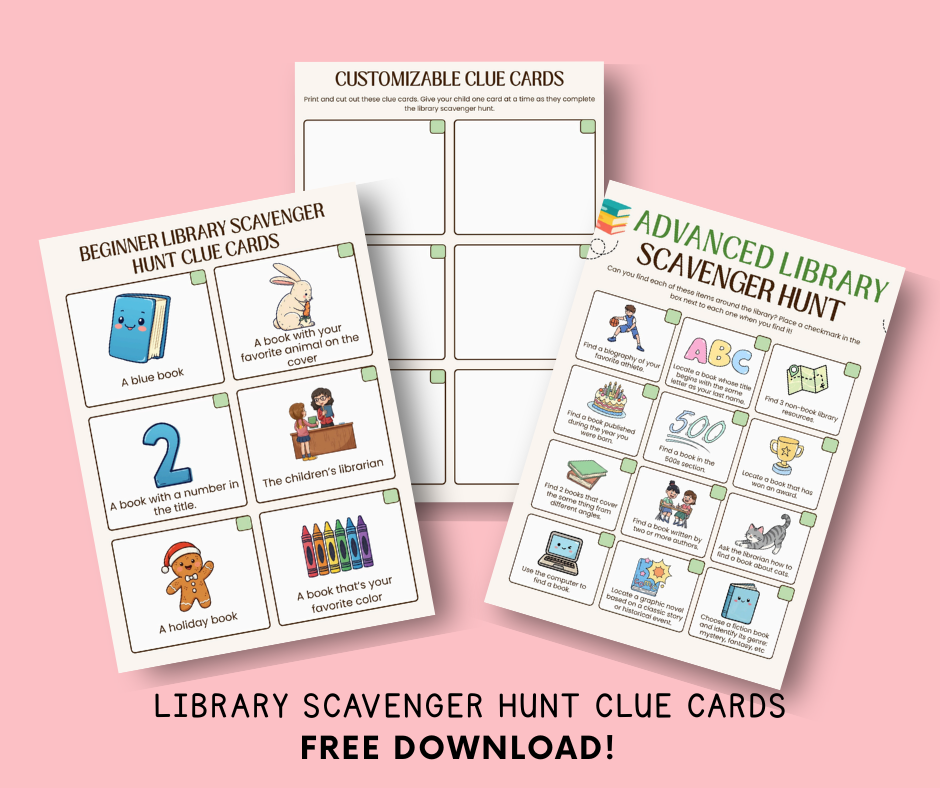
If you do not have time to create your own clues, this free library scavenger hunt printable is ready to go. The pack includes customizable clue cards, a beginner clue set for ages 5–8, and a more advanced set for ages 9–12. Each set has a built-in tracker so children can mark what they have already completed.
You can print the complete set, mix and match cards across age levels, or laminate them to reuse year after year. Print everything in black and white to save ink.
Ready to use these in your homeschool? Enter your email below to get both versions of the free library scavenger hunt printable pack.
More Scavenger Hunts from Affordable Homeschooling
Once your kids discover how much fun learning through scavenger hunts can be, do not stop at the library! Here is every scavenger hunt we have created for homeschool adventures, subjects, and seasons.
4th of July Scavenger Hunt — A fun way to get everyone involved in holiday festivities.
ABC Nature Scavenger Hunt — Encourages children to find things beginning with every letter of the alphabet.
Backyard Scavenger Hunt — The ideal activity to help children discover the magic in their own backyard.
Beach Scavenger Hunt — Fun in the sun awaits your family with this beachy activity.
Bedroom Scavenger Hunt — Perfect for cold days, this hunt will remind your children of toys they forgot they had.
Bird Scavenger Hunt — A great no-prep companion to any bird unit study.
Birthday Scavenger Hunt — Adds sparkle to any birthday party or celebration.
Buddy the Elf Scavenger Hunt — The whole family will be smiling with this holiday-themed challenge.
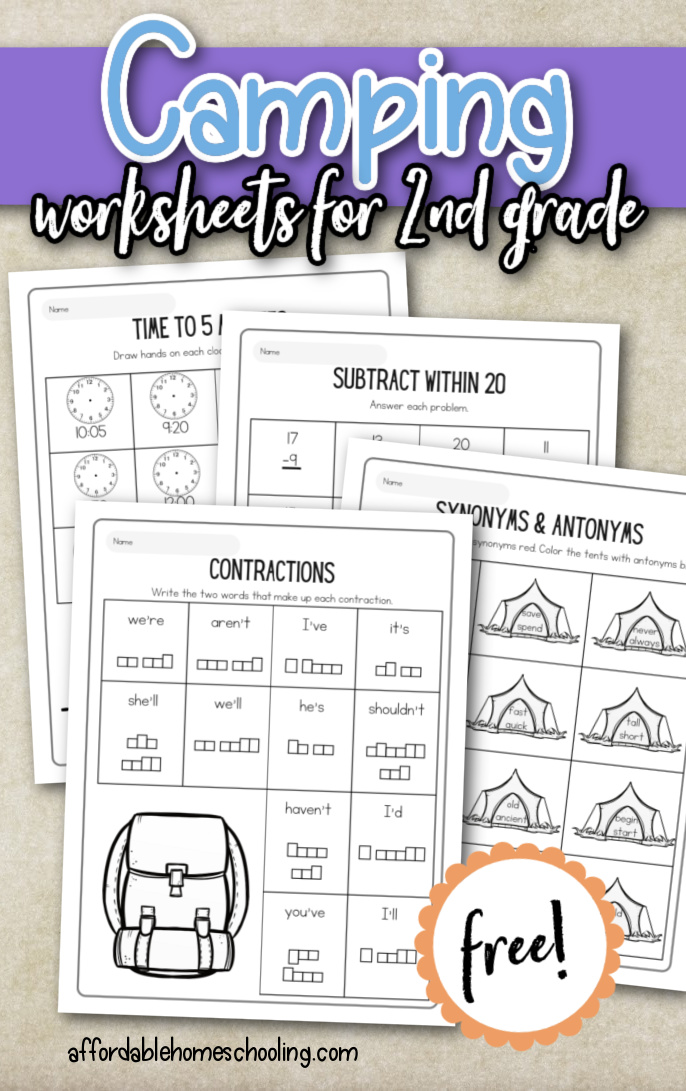
Camping Scavenger Hunt — A simple hunt to make your camping trips even better.
Camping Scavenger Hunt for Older Kids — A challenging activity to pass the time at the campsite.
Fall Leaf Scavenger Hunt — Teaches children about various types of trees while exploring fall color.
Fall Scavenger Hunt — Strengthens visual skills, boosts attention spans, and celebrates the back-to-school season.
Forest Scavenger Hunt — Turn a family walk into an adventure.
Halloween Scavenger Hunt — Spooky, kooky, and plenty of fun for older children.
Nature Scavenger Hunt for Kids — Find leaves, creepy crawlies, and more with this immersive outdoor experience.
Number Scavenger Hunt — Great for preschoolers working on counting sequences.
Playground Scavenger Hunt — Encourages children to see and try new things on the playground.
Pond Scavenger Hunt — Find frogs, butterflies, turtles, and more at your local pond.
Preschool Outdoor Scavenger Hunt — Engage your tots on their next walk around the block.
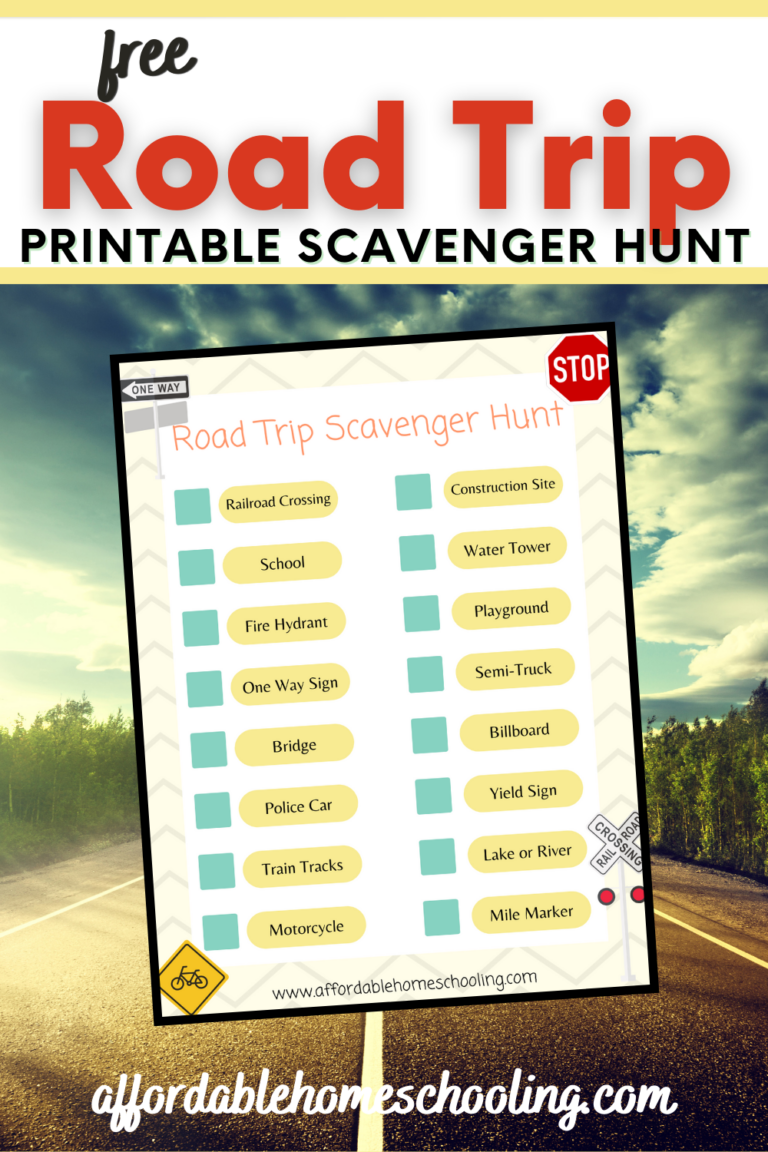
Road Trip Scavenger Hunt — Time flies when you are searching for bridges and fire hydrants!
Sensory Scavenger Hunt — Ignite all your senses with this relaxing, nature-inspired hunt.
Simple Nature Scavenger Hunt — An easy, picture-based hunt to get kids outside.
Simple Summer Scavenger Hunt — With two options, children of all ages can ring in summer with an interactive activity.
Spring Nature Scavenger Hunt — Full of picture clues for kids of all ages.
St. Patrick's Day Scavenger Hunt — Enjoy as a team or solo for a fast-paced challenge.
Star Wars Scavenger Hunt — May the Force be with you as you hunt for lightsabers and Ewoks.
Summer Outdoor Scavenger Hunt — A great screen-free activity for all ages.
Summer Scavenger Hunt — Doubles as an exercise in recognizing letter sounds.
Weather Scavenger Hunt — Works indoors or outdoors, depending on your climate.
Winter Forest Scavenger Hunt — Grab your snowshoes and get ready for a wilderness adventure!
Winter Nature Scavenger Hunt — There is no such thing as bad weather — bundle up and enjoy the season.
Winter Scavenger Hunt — See what winter treasures you can discover in your neighborhood.
Woodland Scavenger Hunt — Rabbits, snails, and more await in your local woods.
Learning how to plan a library scavenger hunt for kids does not require a lot of effort or money, but it can completely change the way your child views this valuable resource. Use the ready-made printable pack, adapt it to your child, and involve your librarian. Do not be surprised if your library scavenger hunt ends with everyone sitting on the floor, already deep in their new favorite book.
Frequently Asked Questions
Planning a library scavenger hunt starts with a conversation with your librarian — they know the space best and can help you identify which areas work well for a hunt and any rules to follow. From there, choose a theme (genre-based, seasonal, author spotlight, or subject-based), write age-appropriate clues, and gather simple supplies like printable clue cards and pencils. Set a few ground rules before you start, decide whether kids will collect books physically or just record titles and call numbers, and you are ready to go. The free printable pack linked above includes ready-made clue sets for ages 5–8 and 9–12 if you want a head start.
For ages 4–6, visual clues with minimal reading work best. Great examples include: find a book with your favorite animal on the cover, find a book that is your favorite color, find a book with a number in the title, and find the children's librarian. The goal at this age is not library navigation — it is helping young children feel comfortable in the space and excited about books. Picture-based clue cards with icons rather than text keep things accessible for pre-readers and early readers.
A well-designed library scavenger hunt teaches kids far more than just where books are shelved. Children practice reading comprehension (interpreting clues), learn the difference between fiction and nonfiction, get an introduction to the Dewey Decimal System, understand what a call number is and how to use it, and practice asking for help from a librarian. Older students build genuine research skills — using the library catalog, locating specific call numbers, and finding non-book resources. Best of all, they leave feeling confident rather than overwhelmed by the library.
Once a year is a great baseline — Fire Prevention Week in October and Fire Prevention Week aside, tying it to a library visit during a new unit study is a natural fit. Many families run one at the start of each school year to refresh library skills, and again in January as a low-key way to kick off second semester. You can reuse the same printable pack with different themes each time, which keeps the activity fresh without requiring new prep work. Laminating the clue cards lets you use them repeatedly.
Yes — always contact your librarian before your visit. Most public library children's departments are very welcoming of this kind of structured visit, and many librarians will enthusiastically help you design clues or suggest areas to include. Calling or emailing ahead lets you confirm rules (quiet voices, designated areas to stay within), find out if there are any areas off-limits, and make sure the library is not hosting another event at the same time. Giving your librarian a heads-up also means they may have resources ready for your group when you arrive.