Fire Safety Activities for Kids: Lessons, Crafts & Free Printable Pack
As an Amazon Associate I earn from qualifying purchases.
Fire safety might not be the subject your children are begging to study, but it is a lesson you will be grateful you taught. Fire Prevention Week (October 6–12) is the perfect time to dig in – and with these fire safety activities for kids, your students will find the topic a lot more enjoyable than you might expect. Within this post you will find games, crafts, role-play, and a free fire safety printable pack. Choose the activities that fit your family, or use them all for a comprehensive unit study.
These activities are great for children ages 3–12 and have plenty of options for adapting to different learning styles. Younger kids love the crafts and games, while older children can practice real life skills like creating an escape plan and knowing how to respond in an emergency. You do not need to buy another curriculum set — these activities provide everything you need for an informative, fun learning time.
Teaching Fire Safety at Home
I used to think fire safety was not as important as other safety topics — then a rogue firework made me rethink that. In the heat of the moment (no pun intended), my daughter floundered. She had no idea what to do beyond hide.
Since that day, I make it a point to intentionally teach fire safety each year. I have found the best time to add a fire safety study to my homeschool is during Fire Prevention Week, which falls on October 6–12. Libraries and children's programming naturally focus on fire safety during this week, so my students are already thinking about it.
Hands-on activities like the ones in this post make it easy for students to remember important concepts. This does not require a fancy set-up or trip to the fire station, either. These activities provide a strong foundation — and the free printable pack at the end ties it all together.
Key Fire Safety Concepts to Cover with Your Kids
Wondering what your kids should actually know about fire safety? Here is your cheat sheet. These are the most important concepts to practice before Fire Prevention Week ends.
- Stop, Drop, and Roll: If a child's clothing catches fire, they need to stop what they are doing, drop to the ground, and roll until the flames go out. Practice this physically — it sticks much better than just talking about it.
- What to Do When a Smoke Detector Goes Off: Kids need to recognize the sound of a smoke detector and understand the game plan the moment one goes off. Does your child know that sound?
- Never Hide From Firefighters: Stranger danger does not apply here. Children should be able to identify a firefighter and feel confident going to them — even if the protective gear looks a little scary at first.
- Family Escape Plan and Meeting Point: Every family member should know where the fire exits are in your home and have one agreed-upon place to meet outside in case of emergency.
- 911 Procedures: Children should be able to call 911 and give their name and address before explaining the emergency. Remind kids that 911 is only for real emergencies and should never be done as a joke.
Fire Safety Activities for Kids
Fire safety can be tricky for parents who want to give their children tools without spreading fear. My daughter struggles with anxiety, and giving scary topics a fun twist helps concepts stick without sending her into a spiral. A mix of activities works best for us, so I have included our favorites below.
Do not feel like you have to do everything. Evaluate your child's learning style and choose what fits their personality and your capacity.
Practice Stop, Drop, and Roll
Hands-on practice is the best stop drop and roll activity for all ages. I keep it simple and lighthearted: clear a space on the carpet, demonstrate what Stop, Drop, and Roll looks like, then let kids repeat the steps until it feels like second nature. The NFPA recommends: Stop (do not run), Drop (drop gently to the ground), Roll (roll over and over until the fire is out). Best for: all ages.
Draw Your Family Escape Plan
The National Fire Protection Association (NFPA) warns that you may have as little as two minutes to escape after the smoke alarm sounds. That means every family member should know the escape plan without hesitation. Together, use our free printable fire escape plan to identify two ways out of each room and draw arrows showing the escape routes. Then choose your family's outdoor meeting spot. Best for: ages 5 and up.
Smoke Detector Scavenger Hunt
One day I asked my then-preschooler where our smoke detectors were. She walked me to our carbon monoxide monitor. Needless to say, we went on a smoke detector scavenger hunt — walking through the house, counting detectors, and testing them so the kids know exactly what that alarm sounds like (and how it is different from other sounds in the house). Best for: all ages, especially preschool.
Role-Play Calling 911
This fire safety lesson for kids doubles as a life skills lesson. Mom or Dad plays the role of 911 operator, asking questions like: What is your name? What is your emergency? What is your address? Is everyone outside? We use a play phone to make the role-playing scenario feel more realistic. Best for: preschool–2nd grade (though every kid can use a refresher).
Fire Safety Sorting Game
Kids ages 3–8 especially love this one. Create laminated cards showing safe and unsafe behaviors. Safe behaviors: staying away from matches, going to the family meeting spot, letting firefighters help you. Unsafe behaviors: playing with matches, going back inside a burning home for toys or pets, opening a hot door, hiding from firefighters. Kids sort the cards into two piles. Best for: ages 3–8.
Firefighter Hat Craft
Kindergarten through 3rd grade kids will have a blast creating their own firefighter hat. This tutorial includes step-by-step photos. While the kids craft, talk about what firefighters do — give a brief overview of their equipment and explain what each piece is for. Best for: Kindergarten–3rd grade.
Fire Safety Pledge Card
Hang our free printable fire safety pledge card on the fridge and review it regularly. To help students take fire safety seriously, have them sign and date the card. Best for: ages 4–10 (most impacted), though all ages can participate.
Fire Safety Word Search
Use our free printable fire safety word search as a quiet activity after hands-on crafting, role-play, and games. Talk about the words as your children find them to reinforce vocabulary and concepts. Best for: 2nd grade and up.
Read a Fire Safety Book Together
All ages can enjoy family read-aloud time. I love theming our read-alouds during Fire Prevention Week with books that reinforce what we have been learning. Some of our favorites:
- Pete the Cat: Firefighter Pete — A fun look inside a fire station and the process firefighters follow when they get a call.
- Fire Dragons for Tea — A silly story about a girl who invites a dragon to tea… and he sets the table on fire. Cute and full of solid fire safety information.
- Stop, Drop, and Roll — My daughter loves this one because it includes music and a catchy song, making it perfect for auditory learners.
- If You Were a Firefighter — Great for kids ages 7 and up. Immersive and nonfiction that reads like fiction, with reflection questions at the end of each chapter.
You can also watch a movie about fire trucks to round out the week in a more relaxed way.
Run a Family Fire Drill
Put your Fire Prevention Week activities to the test with a home fire drill for families. This is a must for the whole family and the single best way to ensure everyone knows what to do when the smoke alarm goes off. (Full step-by-step instructions below.) Best for: all ages.
Free Fire Safety Printable Pack
Fire safety activities for kids should be fun and intentional — and our free fire safety printable pack makes that easy. The pack includes:
- A Fire Safety Word Search
- A blank Fire Escape Plan for your family to fill out together
- A Fire Safety Hero Pledge Card for kids to sign and display
- A “What to Do If There's a Fire” reference sheet to post at home
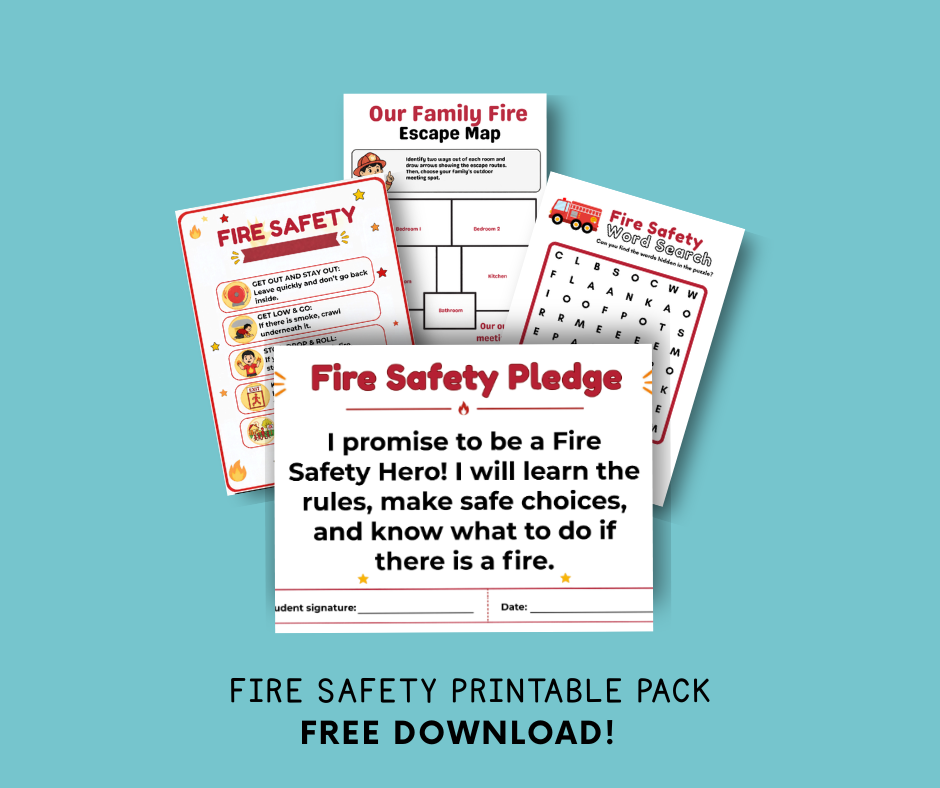
You can print the entire pack or just the pages you need. Everything prints beautifully in black and white to save ink. You can also browse our dedicated free fire safety printables page, which includes additional coloring pages, fire truck diagrams, and labeling activities.
How to Run a Family Fire Drill Step by Step
Kids love acting things out, and I have found that role-playing scary scenarios actually reduces anxiety rather than adding to it. This home fire drill for families is my tried-and-true rehearsal — it covers all the bases and is easy for everyone to follow.
Step 1: Choose Your Meeting Spot
Pick one permanent location that is safely away from the house — somewhere everyone knows, like the end of a long driveway or a neighbor's mailbox.
Step 2: Review Your Escape Routes
Pull out the free fire escape plan printable and walk through the two possible exits from each room. Make sure even the youngest family members know their options.
Step 3: Tell the Kids What You Are Practicing
If you have younger children, a heads-up that a fire drill is happening can reduce fear. It can be hard for preschoolers and early elementary kids to separate what is real from what is practice. Some parents prefer surprise drills — do what works for your family.
Step 4: Start the Drill
Make it feel realistic by setting off the smoke alarm. Everyone moves toward the exit immediately and heads to the designated meeting spot. The end goal: everyone gets out quickly and stays out.
Step 5: Account for Everyone and Discuss
Do a quick headcount. Talk about what worked and what needs adjusting — you may find some escape routes need tweaking. Emphasize that no one goes back inside for anything.
Practice at least once a quarter to keep these concepts fresh. You do not need to make it complicated; you just need to make it happen.
Fire safety may sound intimidating to teach, especially to young children. But if you make it fun and keep the mood positive, it can become one of your best homeschool memories. Grab your free Fire Safety Printables, pick the activities that fit your family, and enjoy — little to no prep required!
Frequently Asked Questions
The most impactful fire safety activities for kids combine physical practice with knowledge. Practicing Stop, Drop, and Roll hands-on (not just talking about it), drawing a family escape plan together, and running an actual home fire drill are the three activities most likely to stick in a real emergency. Role-playing a 911 call is also essential for children ages 3 and up, since knowing their name and address before explaining the emergency can save critical seconds. Layering in crafts, books, and games around Fire Prevention Week (October 6–12) reinforces all of these concepts in a low-pressure way.
Fire safety activities can begin as early as age 3. Preschoolers benefit most from simple, hands-on activities like the smoke detector scavenger hunt, practicing Stop, Drop, and Roll, and hearing fire safety picture books read aloud. They are not too young to learn what the smoke alarm sounds like and where the family meeting spot is. Children ages 5 and up can begin contributing to the family escape plan. By ages 8–12, kids should be able to call 911, explain the emergency, and navigate an escape route independently.
The key is to keep the tone practical and empowering rather than alarming. Frame activities as skills your child is learning, not dangers they should fear. Using games, crafts, and role-play (rather than lectures about worst-case scenarios) keeps the mood positive. Giving kids something to do — a pledge card to sign, a map to draw, a phone to practice on — puts them in an active role rather than a passive, frightened one. Many parents find that children who have practiced what to do are actually less anxious, not more, because they feel prepared.
Stop, Drop, and Roll is the recommended technique if a child's clothing catches fire. According to the NFPA, the steps are: Stop immediately (do not run, because running feeds the flames), Drop gently to the ground and cover your face with your hands, then Roll over and over until the flames are out. Practicing this physically — not just explaining it — is what makes it effective. Kids who have rehearsed the motion are far more likely to remember it under stress than kids who have only heard it described.
The NFPA recommends practicing a home fire drill at least twice a year, though quarterly practice is even better for families with young children. Fire Prevention Week in October is a natural trigger for one drill, and you can schedule a second in the spring. Each drill is also a good opportunity to check smoke detector batteries, review the family escape plan as kids grow and rooms change, and make sure everyone still knows the outdoor meeting spot. Keep it low-key and treat it like any other family routine — not a high-stakes test.